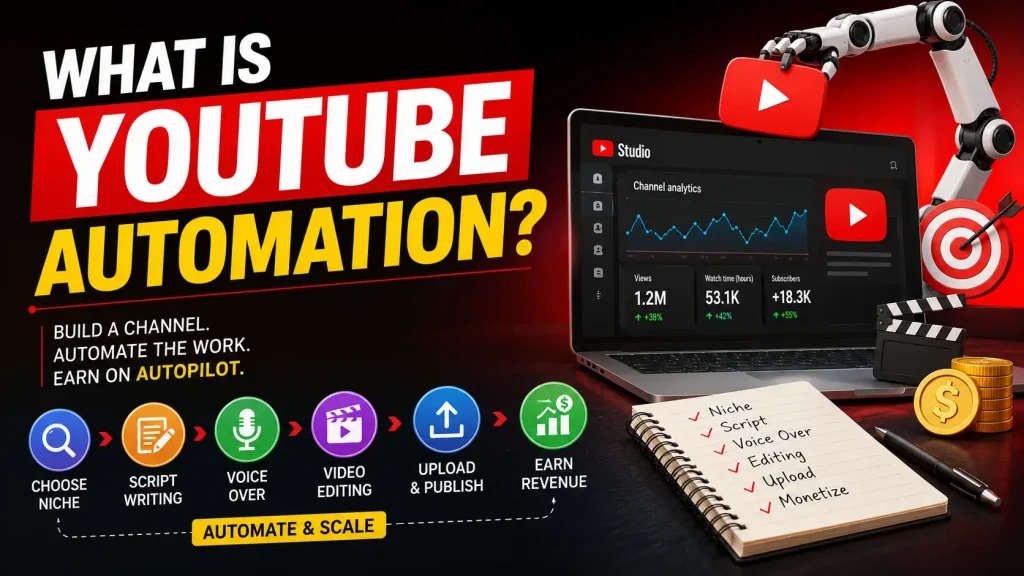
YouTube automation is everywhere in 2026 — the courses, the mentors, the screenshots of $30,000/month income reports. But buried beneath the hype is a real business model, and it deserves a clear-eyed look before you invest a dollar or an hour.
This article covers exactly that: What Is YouTube Automation? actually is, how the production model works, what it costs at different budget levels, and what changed after YouTube’s landmark July 2025 policy update. No fluff, no affiliate links to courses.
“You don’t need to be on camera to be famous. You just need a system.” Here’s what that system actually looks like — and what it costs.
YouTube Automation Explained for Beginners
YouTube automation — also called “cash cow channels” or faceless YouTube — is the practice of running a YouTube channel without appearing on screen. Scripts, voiceovers, visuals, and editing are handled either by freelancers, AI tools, or a combination of both. The channel owner acts more like a media operator than a content creator.
The appeal is obvious: passive income, privacy, scalability. Successful operators run multiple channels simultaneously across different niches, testing markets and audiences the way a publisher manages a portfolio of titles.
Key Definition
The word “automation” is a spectrum — not a binary. Most successful channels sit somewhere between fully manual and fully automated, using AI to accelerate production while humans provide creative direction and quality control.
How the Production Model Works
The Core Workflow
A traditional YouTuber films, edits, and publishes everything themselves. An automation channel separates those roles into a repeatable pipeline. Here’s the typical flow:
1. Ideation & research — A niche topic is identified using tools like VidIQ, TubeBuddy, or OutlierKit, which analyze millions of videos to surface gaps and trending formats.
2. Scripting — A freelance writer or AI (ChatGPT, Claude) drafts a 1,200–2,000-word script. AI output almost always needs a human edit pass — particularly the hook and the call-to-action, which drive watch time more than anything in the middle.
3. Voiceover — Recorded by a voice actor sourced from Fiverr or Voices.com, or generated with AI tools like ElevenLabs. By 2026, AI voiceovers are near-indistinguishable from human narration in most niches.
4. Visuals & editing — Stock footage, AI-generated video clips, or screen recordings are assembled by a video editor or tools like Pictory and InVideo. A well-built template reduces per-video decision-making dramatically.
5. Thumbnail & SEO — Thumbnails are designed in Canva or Photoshop (with AI concept generation from Midjourney). Titles, descriptions, and tags are optimised using keyword tools.
What Does It Actually Cost?
This is where the gap between marketing and reality opens widest. Costs vary enormously based on your production model.
| Approach | Monthly Cost | Cost Per Video | Best For |
|---|---|---|---|
| DIY with AI tools only | $30–$75/mo | $1–$5 | Testing a niche before committing |
| AI tools + some freelancers | $150–$350/mo | $20–$60 | Serious starters, part-time operators |
| Fully outsourced team | $800–$3,000+/mo | $80–$200 | Scaling established channels |
The single most overlooked cost is runway capital — the pre-monetization investment before a channel starts earning. Reaching YouTube’s Partner Program threshold (1,000 subscribers + 4,000 watch hours) typically requires 30–40 videos and 6–12 months of consistent publishing. At $30/video in AI tool costs alone, that’s a $900–$1,200 investment before a single dollar of ad revenue arrives.
Realistic expectation
One documented case: a creator invested $26,311 over 150 days and ended up losing nearly $10,000. This isn’t the norm — but it illustrates that YouTube automation is a real business with real financial risk, not a passive income shortcut.
The July 2025 Policy Update: What Actually Changed
On July 15, 2025, YouTube updated its YouTube Partner Program policies around what it calls “inauthentic content,” — and the automation community felt the impact immediately. Channels that relied on mass-produced, template-based, low-effort automated videos began seeing demonetization warnings. Some lost monetization entirely.
YouTube’s editorial director described it as a “minor update” to existing guidelines. In practice, the enforcement was anything but minor for certain channel types.
What the Policy Targets
❌ Now Banned from Monetization
Mass-produced videos that simply copy content from websites or social feeds with minimal transformation. Repetitive, templated uploads offering no original insight. AI voiceover layered over stock footage with no unique perspective. Batch-uploaded content with zero human creative direction.
✓ Still Fully Permitted
AI-assisted scripting with original editorial voice and human review. AI voiceovers, when paired with genuine storytelling and research. Faceless formats (animation, screen recordings, narrated stock footage) with real creative input. Multi-channel portfolios — as long as each channel meets originality standards.
The core distinction YouTube drew: AI as a production tool is fine. AI as a replacement for creativity is not. Channels using AI to accelerate human-directed content continued to thrive. Channels using AI to manufacture bulk content at zero creative cost took the hit.
The bottom line
Lazy automation is dead. Strategic automation — where a human provides direction, editorial judgment, and quality control — is not only alive but thriving in 2026. The policy change raised the floor for everyone, which actually benefits operators willing to do the work properly.
Who Is This Model Actually Right For?
YouTube automation works best for people who think like business operators, not content creators. If you’re drawn to the idea of managing systems, testing variables, and scaling processes, this model has real potential. If you’re hoping to set up a channel and watch it earn while you do nothing, the 2025 policy changes have effectively closed that door.
The channels performing strongest in 2026 share a few traits: a well-validated niche with strong CPM potential, a consistent publishing schedule (channels with freelance support average 12–15 videos/month vs. 3–4 for solo creators), and a monetization strategy that extends beyond AdSense into affiliate marketing, digital products, or sponsorships.
Is It Worth Starting in 2026?
The honest answer: yes — with significant caveats. The barrier to quality has risen (which is good for serious operators). The tool costs have fallen (AI production stacks now run $30–$75/month vs. $500+ just two years ago). And the monetization paths beyond AdSense — affiliate marketing, digital products, subscription upsells — are more developed than ever.
But it requires upfront capital, patience across a 6–12 month runway, strategic niche selection, and a willingness to treat it as a real business. Anyone selling you a “passive income in 30 days” promise is selling the course, not the outcome.